
By the mid-1990s, the Civic had transformed from an economy car into a cultural phenomenon. The sixth‑generation “Miracle Civic” brought us the legendary Type R, while VTEC engines screamed past 8,000 rpm, rewriting the rules of front‑wheel‑drive performance. But beneath the excitement, a different force was gathering momentum: environmental regulation and rising fuel prices pushed Honda to think beyond the internal combustion engine. The seventh‑generation Civic, launched in 2001, disappointed some enthusiasts with its simpler suspension, yet it carried something far more consequential—the first Civic Hybrid. That car introduced the world to Honda’s Integrated Motor Assist system and, crucially, its nickel‑metal hydride battery pack. This marked the beginning of a new chapter, where battery chemistry would become as important as valve timing.
The Miracle Civic Arrives
When the sixth-generation Civic (chassis code EK) debuted in September 1995, Honda called it “Miracle Civic”—a name that proved remarkably prescient. This was the generation that finally brought the Civic to Chinese shores as an official import, with the three-box sedan earning the affectionate nickname “Big-Eye Civic” for its distinctive headlamp design. But the real miracle happening under the skin was the arrival of the first-ever Civic Type R (EK9) in August 1997, elevating Civic from a sensible economy car into a bonafide performance icon. Honda‘s engineers started with the B16B engine—derived from the larger B18C but modified with a longer stroke—hand-assembled by master technicians using lightweight materials. The result was an astonishing 185 horsepower from 1.6 liters naturally aspirated, redlining at a stratospheric 8,400 rpm. More than just straight-line speed, Honda seam-welded the monocoque chassis, fitted a helical limited-slip differential, upgraded the suspension, and wrapped everything in Bridgestone Potenza RE010 tires. The EK9 rewrote the rulebook for front-wheel-drive performance and cemented Civic’s place in automotive folklore.
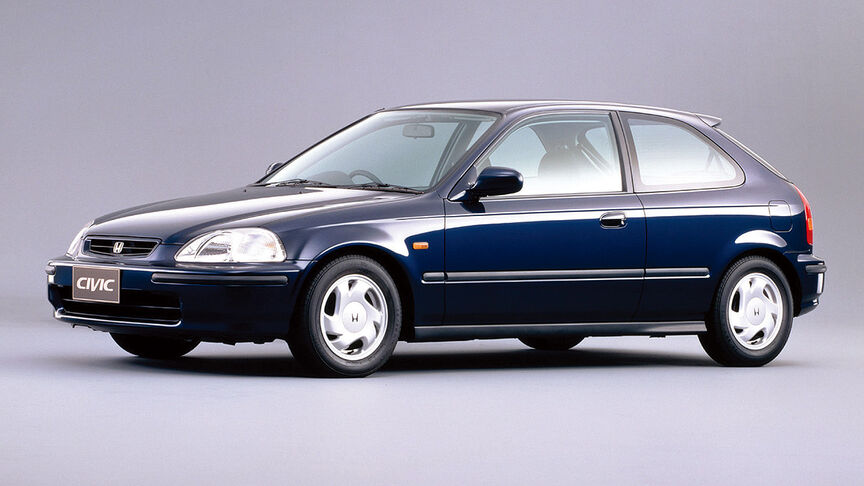
However, not everything about the sixth generation was about screaming VTEC engines and track-day heroics. The broader Civic lineup underwent subtler but equally important evolutions: a Multimatic continuously variable transmission (CVT) debuted on the 1.6i ES, marking the first time Honda offered a CVT on a Civic. Engines gained 3-stage VTEC variable valve timing, enhancing both performance and fuel economy. The Civic also became the first model in its class to pass California’s stringent ULEV (Ultra Low Emission Vehicle) standards, foreshadowing a growing environmental consciousness that would come to define the next generation.
Controversy in the Name of Progress: The Seventh Generation (2000–2005)
The seventh-generation Civic, launched for the 2001 model year under the slogan “Global Civic”, arrived with design intentions that alienated a significant portion of the faithful fanbase. Honda switched the front suspension from the beloved double-wishbone configuration to a more conventional MacPherson strut design. The reason was practical: MacPherson struts were cheaper to manufacture and occupied less space in the engine bay, allowing room for the new K-series engine family. Enthusiasts cried foul. The new front setup, they argued, offered reduced suspension travel and less precise steering feel, betraying a heritage built on handling excellence. But in the cold calculus of product development, Honda had made the right call. The seventh-generation Civic sold in massive volumes, and its improvements—a stiffer chassis with reduced flex, a flat rear floor that maximized cabin space, and improved crash protection—made the car more appealing than ever to mainstream buyers.
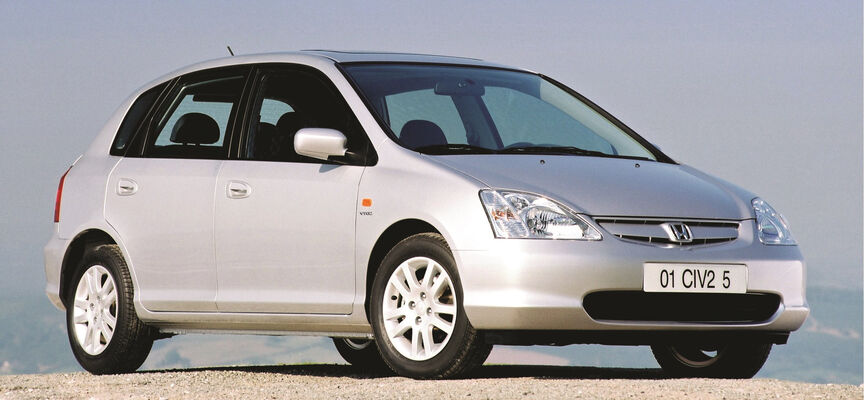
Yet what enthusiasts decried as compromise, history would recognize as preparation. The seventh-generation Civic‘s greatest legacy lay not in its chassis dynamics but in its powertrain strategy. In 2002, Honda unveiled the first Civic Hybrid, based on the seventh-generation platform. This wasn’t just a clever marketing exercise. It was proof that mass-market hybrids could work without the bulbous aerodynamic shapes that made the Toyota Prius immediately identifiable. The Civic Hybrid looked like a regular Civic sedan—subtle differences included a unique front bumper fascia, a small trunk-lid spoiler, and special alloy wheels—but underneath, everything had changed.
The IMA System: A Different Kind of Hybrid
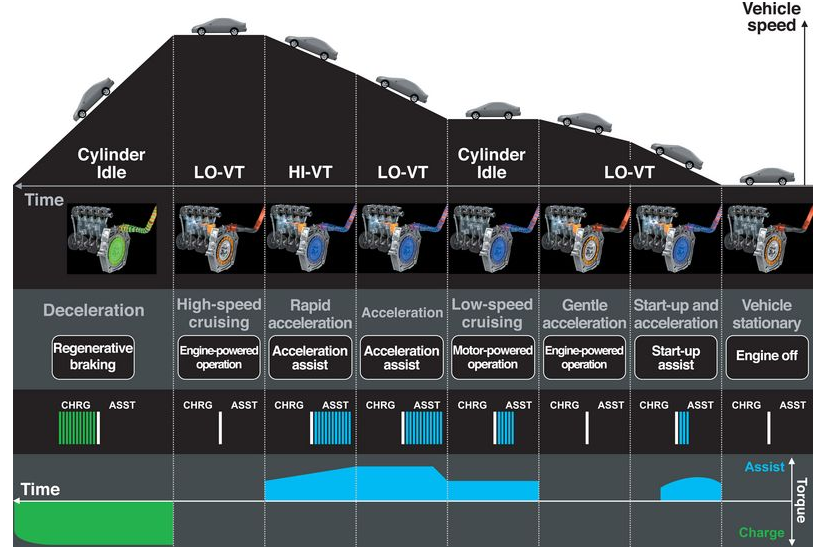
Honda’s Integrated Motor Assist (IMA) system took a fundamentally different approach to hybrid propulsion than Toyota’s more complex series-parallel arrangement. First introduced on the two-seat Insight in 1999, IMA was elegantly simple: a conventional internal combustion engine acted as the primary power source, and a thin, compact DC brushless electric motor/generator—only 60 mm wide—nestled between the engine and transmission provided supplementary power when needed. When additional torque was called for (hard acceleration, climbing hills, or overtaking), the motor seamlessly contributed boost. Under deceleration, the same unit reversed roles: it functioned as a generator, converting kinetic energy into electrical energy rather than wasting it as heat through conventional friction brakes, a process known as regenerative braking. The system also incorporated an idle-stop feature, automatically shutting off the engine at traffic lights and restarting it instantly when the accelerator pedal was pressed.
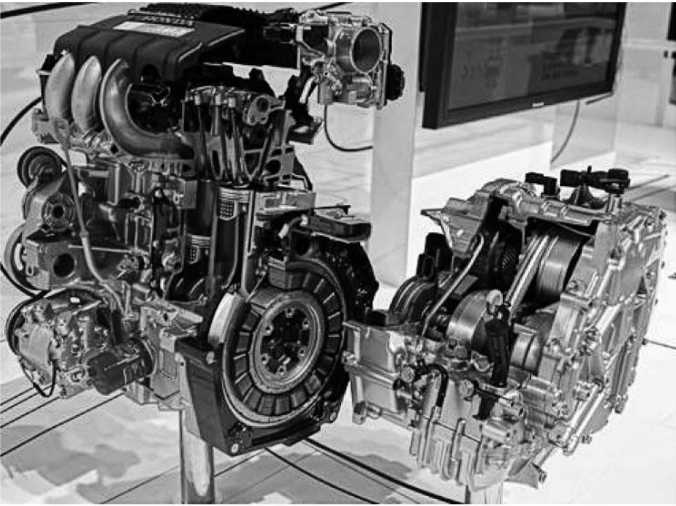
Crucially, the Civic Hybrid’s IMA battery pack was a nickel-metal hydride (NiMH) unit—120 volts with 6.0 Ah capacity—housed in an Intelligent Power Unit (IPU) behind the rear seat. Compared to the NiMH pack in the earlier Insight, Honda engineers had reduced the IPU volume by an astonishing 42 percent, proving that nickel-metal hydride technology could be miniaturized for mass-market applications. The battery management system kept the NiMH pack operating within a narrow state-of-charge window—typically 50 to 60 percent—maximizing cycle life. Under normal conditions, Honda designed these NiMH packs to last ten years. The emotional heart of the hybrid drive was this silent partnership on the rear seat: a technology that worked best when the driver never noticed it at all.
The Nickel-Metal Hydride Advantage
Why did Honda choose NiMH when lithium-ion batteries were already available? The answer reveals why NiMH remains an underappreciated engineering triumph even today. NiMH batteries operate at a nominal voltage of 1.2 volts per cell and offer energy densities between 60 and 140 Wh/kg—respectable if not spectacular by modern standards. Their advantages lay elsewhere. NiMH chemistry provides excellent power output characteristics regardless of state-of-charge, meaning the IMA system could deliver consistent electric assistance whether the battery was half full or nearly depleted. Furthermore, NiMH batteries tolerate deep cycling remarkably well. For hybrid applications where the state-of-charge swing is less than five percent, NiMH packs can exceed 300,000 charge-discharge cycles while maintaining sufficient performance—dramatically more than lithium-ion packs of the same era.
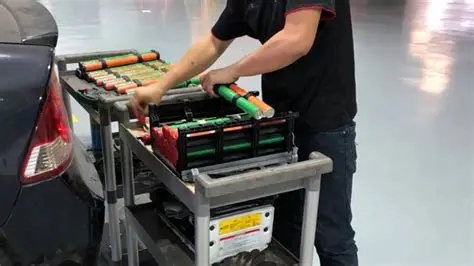
Safety also favored NiMH. The alkaline electrolyte (potassium hydroxide) is far less flammable than the organic solvent electrolytes used in lithium-ion batteries. Thermal runaway—the catastrophic chain reaction that can cause lithium-ion packs to ignite—is essentially impossible with properly managed NiMH chemistry. This safety margin was particularly important in the early 2000s, when lithium-ion battery fires in consumer electronics were receiving widespread media attention. While Honda recognized that lithium-ion offered higher energy density and lighter weight—and would eventually transition the Civic Hybrid to lithium-ion for the ninth generation—the company wisely concluded that NiMH was the mature, proven, and ultimately safer technology for early mass-market hybrid adoption.
But the NiMH pack in the first-generation Civic Hybrid was not without its challenges. Under certain driving conditions, particularly frequent stop-and-go city driving with the air conditioning running, the IMA system could leave the NiMH battery in a low state of charge. Over time, deep discharge accelerated degradation, and some early packs failed prematurely—a painful lesson Honda learned quickly. The company responded with a series of software updates (Technical Service Bulletins 09‑058 and 10‑034) that modified the IMA control strategy, essentially “detuning” the system to use electric assist less aggressively in order to reduce stress on the battery. Owners complained that acceleration felt slower after the update, but the trade-off extended battery life.
The seventh-generation Civic Hybrid, with its compact NiMH pack and IMA philosophy, represented a remarkable engineering achievement: a hybrid vehicle that delivered 46 mpg in the city and 51 mpg on the highway while looking and driving like an ordinary Civic. It earned SULEV (Super Ultra Low Emission Vehicle) certification and, through Honda‘s cylinder-idling system, could shut down up to three of its four cylinders during deceleration—an early glimpse of the cylinder-deactivation technology that would later become widespread in the industry. Most importantly, the Civic Hybrid proved to a skeptical public that hybrid technology could work without oddball styling or compromised practicality. The revolution had begun, and at its core sat nickel-metal hydride.