
A Decision Made in the Caribbean Heat
Kevin ran a used battery business in Barbados for eight years. His warehouse in Bridgetown was nothing fancy – just rows of shelves stacked with reconditioned batteries, a test bench in the corner, and a small office with a humming air conditioner that barely kept up with the Caribbean heat.
He bought old cores from garages, scrap yards, and auctions. He tested each one. The ones that still had life went back on the shelf. The ones that didn’t got stripped for parts. It was an honest way to make a living, and for a long time, it worked.
But the past two years had been getting harder.
Good used batteries were becoming scarce. More cars were using AGM and EFB technology, which didn’t recondition as well. Scrap lead prices had climbed, squeezing his margins. And every week, at least two or three customers would ask the same question: “Can you get me a new battery? I don’t mind paying more if it lasts longer than a year.”
Kevin would shake his head and point them to a local auto parts store. Each time, he watched a sale walk out the door.
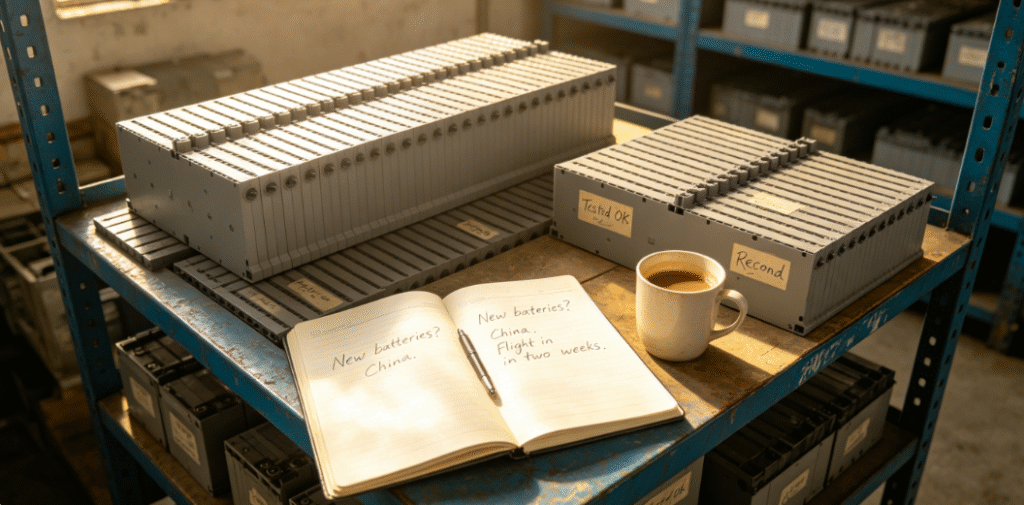
He knew he had to change. The real opportunity wasn’t in second-hand anymore. It was in new batteries – good ones, priced fairly, delivered reliably. But Barbados is a small market. Local distributors marked up prices by 40% or more. The only way to get a real deal was to go straight to the source.
So Kevin sat down with his wife one night and said: “I’m going to China.”
She thought he was crazy. Two weeks later, he booked a flight.
A Late-Night Reply from Across the Ocean
Before he left, Kevin spent night after night on Alibaba, searching for battery manufacturers. He typed in “car battery supplier China” and scrolled through page after page. Dozens of companies. Hundreds of listings. Most looked the same – stock photos, vague descriptions, and promises that felt too good to be true.
He sent messages to eight different suppliers. Five replied within 24 hours. Four of those sent him the exact same catalog, just with different logos pasted on top. One quoted him a price that was so low it was obviously impossible. Another never answered his follow-up questions.
Then he found YASTE.
What caught his eye wasn’t the product photos, though those were clear and detailed. It was the response rate: “100% within 1 hour.” And under the reviews, a short comment from a buyer in Trinidad: “The sales rep Perry solved my shipping problem in two hours. No excuses. Will buy again.”
Kevin sent a message: “Hi, I’m Kevin from Barbados. I sell used batteries here but I want to move into new ones. I’m flying to China next week to visit suppliers. Can I come see your factory?”
Twenty minutes later, his phone buzzed. It was past 11 PM in China.
“Kevin, this is Perry from YASTE. Welcome. Send me your hotel details once you have them. I’ll pick you up and show you everything. No hidden corners. What battery sizes do you sell the most? Tell me and I’ll prepare samples for you to take back.”

Kevin read the message twice. No other supplier had offered to pick him up. No one else had asked about his specific sizes. He replied with a list: group sizes 24, 27, 34, 35, and 48 – the most common for Japanese and American cars in Barbados.
But he had been burned before. He told himself not to get excited. He planned to visit at least five factories before making any decision.
Six Factories, Six Disappointments
Kevin landed at Guangzhou Baiyun Airport on a Monday morning. The humidity hit him like a wall. He had booked a small hotel near the industrial district and printed out a list of six suppliers he wanted to see, including YASTE.
The first factory he visited was in Huadu District. Big showroom. Marble floors. A sales manager in a crisp suit welcomed him with tea and a PowerPoint presentation. The slides showed impressive numbers: annual output, export countries, ISO certificates. But when Kevin asked to see the production line, the manager hesitated. After some persuasion, they walked to the back. The floor was messy. Workers were manually pasting plates – no automation. Kevin took photos but said nothing.
The second factory quoted him prices that were 20% lower than anyone else. That should have been a red flag, but Kevin was tired and tempted. He asked for test reports. The salesperson smiled and said, “We have them, but they are confidential.” Kevin walked out.
The third factory was the opposite. Polite, professional, and painfully slow. It took them three days to send him a simple quotation. By the time they replied, Kevin had already moved on.
The fourth was a large operation in Shenzhen. Their sales manager proudly showed him an “automated production line.” Kevin watched for a while and realized only one section was automated – the rest was still manual. When he pointed this out, the manager shrugged. “Same result,” he said. “Cheaper labor.”
By Thursday afternoon, Kevin was exhausted and deeply discouraged. He sat in a small restaurant near his hotel, scrolling through his notes. Six factories visited. None felt right.

He texted Perry: “Perry, I’ve seen four factories so far. Maybe five. I’ve lost count. They all look good online but feel wrong in person. I’m not sure anymore.”
Perry replied within minutes: “Come see us tomorrow. If you don’t like what you see, you can fly home with no hard feelings. But at least you’ll know you saw one real one.”
The Hour-Long Drive That Changed Everything
The next morning, Perry pulled up to Kevin’s hotel in a clean but unremarkable sedan. She got out, waved, and smiled. No suit. Just a company polo shirt and a pair of sturdy shoes.
“You ready?” she asked.
Kevin nodded. They drove for about an hour. Perry didn’t talk about herself or the company’s awards. Instead, she asked Kevin about Barbados – the market, the weather, the common car models, the problems his customers complained about. She took notes on her phone.

When they arrived at the YASTE factory, Perry didn’t lead him to a conference room. She took him straight to the raw material warehouse.
“Most battery failures start here,” she said, pointing at stacks of lead ingots and rolls of separators. “If the material is bad, nothing after it matters. We test every batch before it goes into production. I’ll show you the logs.”
She opened a binder – actual printed records, not a screen. Batch numbers, test dates, results, initials. Kevin flipped through a few pages. Everything was there.
Then they walked through the pasting line. Perry pointed to a digital scale that weighed every plate automatically. “If the paste weight is off by more than 2%, the line stops and a supervisor has to reset it. We don’t guess.”
Next was the assembly area. The machines were not brand new, but they were clean and well-maintained. Perry showed Kevin how the welding was done – consistent, no cold joints. She picked up a finished plate group and bent it slightly. “See how it holds? That’s good welding.”
The formation room was where Kevin’s eyes widened. Perry opened a computer dashboard on a wall-mounted screen. It showed real-time data for every battery in formation – voltage, temperature, time elapsed. “We monitor each one individually. If a battery goes out of spec, the system flags it automatically. We don’t ship it.”
Finally, the testing lab. A YASTE battery was running a deep-cycle test. The counter on the machine read 152 cycles. Voltage was still stable. Perry handed Kevin a USB drive. “Production records from the last three months. Every batch, every test, every shipment. Take it home. Look at it on your own time.”
Kevin asked: “What if I need different terminal positions? For some European cars. We get a few BMWs and Mercedes in Barbados.”
“We can customise,” Perry said. “Normally custom cases and terminals require 500 pieces per model. But for your first order, I can talk to the production manager and try to get you 200. I’ll send you a technical drawing within a week for approval.”
No other factory had offered that. No one else had shown him real production data before an order. No one else had picked him up from a hotel and driven an hour each way.
That night, Kevin called his wife. “I think I found the one,” he said. “But let me sleep on it.”
The Five Days of Silence
Kevin flew back to Barbados on Sunday. He spent Monday unpacking samples and organizing his notes. On Tuesday, he sent Perry a list of six battery models for a trial order – 50 pieces of each, 300 total.
Perry confirmed availability within two hours and sent a proforma invoice. Kevin reviewed it, asked one question about terminal torque specs, got an answer in thirty minutes, and paid the 30% deposit.
Then nothing.

For five days, Perry didn’t reply to Kevin’s messages. Kevin checked WhatsApp every few hours. The messages showed two blue checks – read. But no reply. He sent an email. Nothing. He sent another WhatsApp message. Read, no reply.
He started to panic. Had he been scammed? Was this how it worked – take the deposit and disappear? He called the phone number on the proforma invoice. It rang twice and went to voicemail.
He asked a different contact at YASTE – someone whose name he found on the company website. The reply came back: “Perry is at a big exhibition in Shanghai this week. Very busy.”
Kevin was furious. He had flown across the ocean. He had trusted this woman. He had paid a deposit. And now she was too “busy” to answer a single message?
He sent one last message, longer and angrier than he intended: “Perry, I didn’t come all the way from Barbados to be treated like this. I am not one of your exhibition walk-ins. I am a customer who paid you money. If you can’t communicate, tell me now. I will find someone else and dispute the deposit.”
The reply came two hours later. Perry apologized. She said she had been managing over 300 leads from the exhibition and had dropped the ball. She said it wouldn’t happen again.
Kevin didn’t care. The excuse didn’t matter. The trust was gone.
He started looking at other suppliers again. He called the polite-but-slow factory and asked if they could expedite a trial order. They said they would try. He didn’t believe them.
A Video, No Excuses
A week passed. Kevin hadn’t placed any order with anyone else. He was stuck. The samples from other factories were still sitting in his luggage, untested. Something kept nagging at him.
Then Perry did something unexpected.
She didn’t send a long apology. She didn’t send flowers or a gift – he would have found that fake. She didn’t beg for another chance.
She simply sent him a video.
The video was filmed on a smartphone, no editing. It showed a production line at YASTE. A worker was assembling batteries. Perry’s voice came from behind the camera: “Kevin, these are your batteries. Batch number Y2403-18. Watch.”
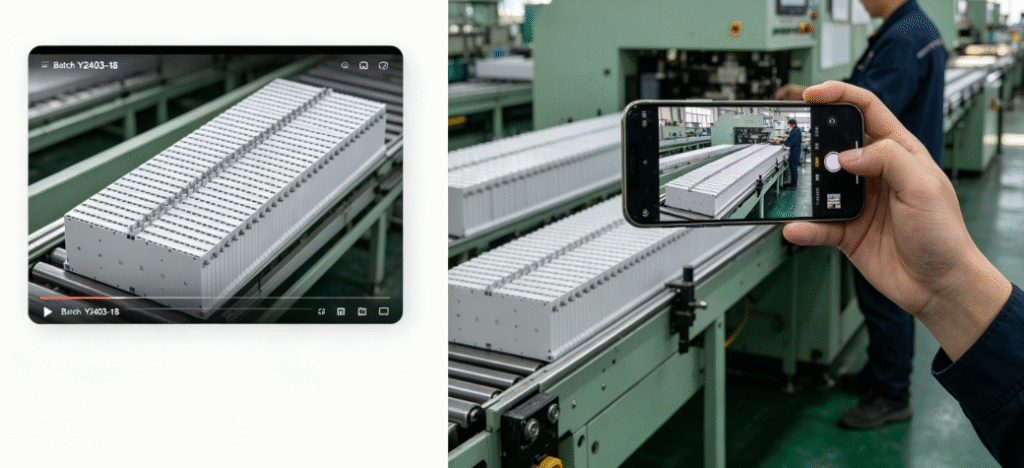
The camera zoomed in on the label on the side of a battery. It showed Kevin’s specifications – group size 19.2V, terminal type SAE, CCA rating 650. Then it showed a test printout from the formation system, with Kevin’s name written on top in marker.
Perry’s voice continued: “The communication was my fault. No excuse. But I never stopped working on your order. All 300 pieces are in formation right now. They will be ready in four days.”
Then she sent a second message, typed: “I also found a forwarder who specialises in Caribbean DG shipments. Their rate to Bridgetown is 12% cheaper than the quote I gave you earlier. I’ve attached their contact. Use them or don’t – no pressure. If you want to cancel, I will refund your deposit in full today. Just say the word.”
Kevin watched the video three times. He zoomed in on the test printout. The numbers matched his requirements. The date stamp was from two days ago – Perry had been working on his order while ignoring his messages. She had done the opposite of what he assumed.
He sat on his couch for a long time. His wife asked what was wrong. He showed her the video. She watched it and said, “She’s not a liar. She’s just bad at texting.”
Kevin called Perry. She answered on the first ring.
“You should have told me you were working on it,” Kevin said. His voice wasn’t angry anymore. Just tired.
“You’re right,” Perry said. “I got buried in the exhibition and I forgot that a customer needs updates, not just product. I focused on the factory floor and forgot to talk to you. That won’t happen again. I’ve set up a reminder system now. Every Monday, every customer gets an update. Even if nothing has changed.”
Kevin was quiet for a moment. Then: “Ship the batteries.”
Shipments and Mondays
The shipment left Xiamen on a Thursday. Four weeks later – delayed by a storm near Puerto Rico – the container arrived at the port in Bridgetown. Kevin cleared customs, brought the pallets to his warehouse, and started testing.
Every single battery passed. The cold-cranking amps were within 2% of the spec. The terminal torque held. The voltage after sitting for 48 hours was 6.2V or higher on all 300 pieces.
Kevin sold the first batch in ten days. That had never happened with used batteries – he usually sat on inventory for weeks. A local taxi fleet owner bought 40 pieces after testing one on his personal Highlander. A garage that had never bought from Kevin before asked for a price list.
Over the next six months, Kevin placed four more orders with Perry. Each one was slightly larger than the last. He stopped promoting used batteries almost entirely. New YASTE batteries became 70% of his revenue. He hired a part-time helper to manage the increased volume.
Perry never missed a Monday update again. Every week, Kevin received a short, no-nonsense message: “Your order is in pasting this week.” “Formation done, passing CCA.” “Shipment booked for Friday, here is the container number.”
One evening, after a particularly smooth delivery, Kevin sent Perry a voice message: “You know why I stayed? Not because of the test reports, though those were good. Not because of the price, though that was fair. Because when you messed up, you showed me the batteries were already made. You didn’t lie. You didn’t blame anyone else. You just fixed it and moved on. That’s hard to find.”
Perry’s reply was short: “Thanks, Kevin. Let’s keep going.”
What He Brought Back to Barbados
Kevin still runs his business in Barbados. Perry still works the late shift at YASTE, answering messages from customers scattered across time zones. They don’t use flowery words. They don’t call each other “partners for life” or any of that. They just get things done.
When other Caribbean buyers ask Kevin for supplier recommendations, he gives them Perry’s contact. “Tell her Kevin sent you,” he says. “And don’t expect her to reply during exhibition week. But expect your batteries to be ready.”
Kevin flew to China expecting to find a product. He found someone who knew her stuff, dropped the ball, picked it back up, and never let it fall again.
That was enough.